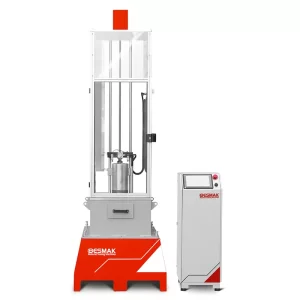

SHOCK ABSORBER TESTING MACHINE FOR DYNAMIC AND FATIGUE PERFORMANCE EVALUATION – BMT-D/SA
The Shock Absorber Testing Machine from BESMAK is a high-performance servo-hydraulic testing system designed for dynamic, static, fatigue, and durability testing of automotive shock absorbers and suspension components. With a dynamic load capacity of up to 25 kN and advanced closed-loop control technology, this system delivers accurate, repeatable, and standards-compliant test results for research laboratories, automotive manufacturers, and quality control facilities.
What is a Shock Absorber Testing Machine?
A Shock Absorber Testing Machine is used to evaluate the performance, durability, damping characteristics, and fatigue behavior of shock absorbers under real operating conditions. The system simulates cyclic loading, vibration, and dynamic forces to ensure product reliability and long-term performance.
The BESMAK BMT-D/SA system is specifically developed to perform dynamic tests, sliding tests, friction tests, gas pressure tests, and life-cycle tests according to international testing standards.
Key Features of the BESMAK Shock Absorber Testing Machine
Servo-Hydraulic Dynamic Testing System
- Dynamic load capacity up to 25 kN
- Double-acting servo-hydraulic actuator
- High-speed testing capability up to 1000 mm/s
- Stroke length of ±75 mm
High Precision Measurement
- Closed-loop servo control technology
- High-resolution displacement measurement (0.01 mm)
- Precision load measurement system
- ISO 7500-1 compliant load accuracy
Advanced Fatigue Testing Capability
- Continuous testing up to 2,000,000 cycles
- Adjustable frequency and amplitude
- Realistic simulation of operating conditions
- Long-term durability evaluation
Flexible Testing Configurations
- Simultaneous testing of up to 5 samples
- Multiple grip and fixture options
- Suitable for different shock absorber designs
- Customizable test procedures
Applications of Shock Absorber Testing Machine
The BESMAK Shock Absorber Testing Machine is widely used in:
- Automotive suspension testing
- Shock absorber durability testing
- Damper performance evaluation
- Fatigue and life-cycle testing
- R&D laboratories
- Automotive OEMs
- Component manufacturers
- Quality control laboratories
- University research centers
Testing Capabilities
The system can perform:
Dynamic Shock Absorber Testing
- Evaluate damping characteristics under dynamic loading conditions.
Fatigue Testing
- Analyze long-term durability through millions of loading cycles.
Sliding Force Testing
- Measure friction behavior and sliding resistance.
Gas Pressure Testing
- Assess gas pressure performance and stability.
Life Cycle Testing
- Simulate real-life operating conditions to determine product lifespan.
Static Load Testing
- Measure static stiffness and load-bearing characteristics.
Advantages of BESMAK Shock Absorber Testing Machine
- High stiffness four-column frame design
- Advanced servo-hydraulic control system
- High-speed actuator performance
- Excellent repeatability and accuracy
- Long service life
- User-friendly software interface
- Reliable fatigue testing capability
- Customizable testing solutions
- Worldwide technical support
Why Choose BESMAK?
With more than 30 years of experience in material and component testing systems, BESMAK provides innovative testing solutions trusted by laboratories, automotive manufacturers, and research institutions worldwide. Our Shock Absorber Testing Machine combines precision engineering, advanced control technology, and reliable performance to meet the most demanding testing requirements.
Frequently Asked Questions (FAQ)
What is a Shock Absorber Testing Machine used for?
A Shock Absorber Testing Machine is used to evaluate the durability, damping performance, fatigue resistance, and overall reliability of automotive shock absorbers.
Can the machine perform fatigue testing?
Yes. The system can perform continuous fatigue tests up to 2,000,000 cycles.
What is the maximum load capacity?
The BESMAK BMT-D/SA offers a dynamic load capacity of up to 25 kN.
Which industries use Shock Absorber Testing Machines?
Automotive manufacturers, suspension component suppliers, R&D laboratories, universities, and quality control centers commonly use these systems.