

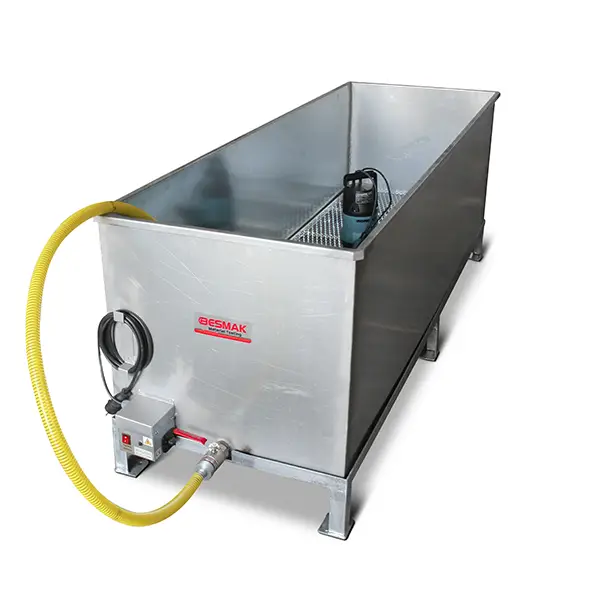
CURING TANK FOR CONCRETE SPECIMENS – BCO-110
Concrete curing is one of the most critical stages in determining the final strength and durability of concrete specimens. BESMAK Curing Tanks are designed to provide a stable curing environment for concrete cubes and cylinders by maintaining the required temperature and preventing moisture loss throughout the curing process. Manufactured for laboratory and construction quality control applications, BESMAK curing tanks are available in galvanized steel, stainless steel, and plastic versions. Each system is equipped with a circulation pump and thermostat to maintain the standard curing temperature of 20 ± 2°C according to international testing standards. Whether for routine concrete quality control or advanced laboratory testing, BESMAK curing tanks ensure reliable and repeatable curing conditions.
Standards:
- EN 12390-2
- BS 1881:111
- ASTM C31
- C192
- C511
- AASHTO T23
Features of BESMAK Curing Tanks
- Designed for curing concrete cube and cylinder specimens.
- Maintains stable temperature throughout the curing process.
- Prevents moisture loss from specimens.
- Available in galvanized steel, stainless steel, and polyurethane plastic construction.
- Equipped with circulation water pump.
- Thermostat-controlled temperature regulation.
- Standard curing temperature: 20 ± 2°C.
- Suitable for laboratory and field quality control applications.
- Complies with international concrete testing standards.
Available Curing Tank Models
BCO-110/1 Small Curing Tank
- Dimensions: 610 × 610 × 580 mm
- Weight: 55 kg
- Power Supply: 220 V, 50 Hz
Suitable for laboratories requiring compact curing capacity for routine concrete specimen testing.
BCO-110/2 Big Curing Tank
- Dimensions: 650 × 2000 × 640 mm
- Weight: 74 kg
- Power Supply: 220 V, 50 Hz
Designed for high-volume concrete testing laboratories with larger specimen storage requirements.
BCO-110/4 Plastic Big Curing Tank
- Dimensions: 92 × 197 × 84 cm
- Power Supply: 220 V, 50 Hz
Manufactured from durable plastic material offering corrosion resistance and long service life.
Optional Accessories and Additional Equipment
BESMAK also offers a complete range of curing tank accessories and auxiliary equipment:
- Curing Tank Heating and Cooling System (BCO-10/6)
- Accelerated Curing Tank (BCO-10/11)
- Accelerated Curing Tank 1000×750×750 mm (BCO-10/12)
- Heater for Curing Tank (BCO-10/13)
- Circulation Water Pump for Curing Tank (BCO-10/14)
These accessories help laboratories maintain precise environmental conditions and improve curing efficiency.
Applications of Concrete Curing Tanks
Concrete curing tanks are widely used in:
- Construction material testing laboratories
- Ready-mix concrete plants
- Universities and research institutions
- Infrastructure projects
- Quality control laboratories
- Cement and concrete production facilities
Proper curing ensures accurate compressive strength and flexural strength test results by providing consistent moisture and temperature conditions.
Why Choose BESMAK Curing Tanks?
BESMAK curing tanks are designed to deliver reliable curing conditions for concrete specimens while meeting international testing requirements. Their durable construction, precise temperature control, and flexible sizing options make them an ideal solution for laboratories seeking accurate and repeatable test results.
Benefits include:
- Long-lasting construction
- Uniform water circulation
- Precise temperature control
- Easy maintenance
- Multiple size options
- Compliance with global testing standards
International Standards
BESMAK Curing Tanks comply with:
- EN 12390-2
- BS 1881:111
- ASTM C31
- ASTM C192
- ASTM C511
- AASHTO T23
These standards define the requirements for curing concrete specimens before strength testing.
FAQ
What is a curing tank used for?
A curing tank is used to maintain concrete specimens under controlled temperature and moisture conditions before strength testing. Proper curing helps concrete achieve its designed strength and durability.
What temperature should a concrete curing tank maintain?
According to international standards, curing tanks should maintain a temperature of 20 ± 2°C to ensure accurate and consistent curing conditions.
Why is curing important for concrete specimens?
Curing prevents moisture loss and allows the hydration process to continue, resulting in improved strength, durability, and reliable test results.
What types of specimens can be cured in a curing tank?
Curing tanks are commonly used for concrete cubes, cylinders, and other concrete specimens prepared for compressive and flexural strength testing.
What standards apply to concrete curing tanks?
Common standards include EN 12390-2, ASTM C31, ASTM C192, ASTM C511, BS 1881:111, and AASHTO T23.
What is the benefit of a circulation pump in a curing tank?
The circulation pump ensures uniform water temperature throughout the tank, providing consistent curing conditions for all specimens.
| Product Code | Product Name |
|---|---|
| BCO-110/1 | Small Curing Tank |
| BCO-110/2 | Big Curing Tank |
| BCO-110/4 | Plastic Big Curing Tank |
| BCO-110/6 | Curing Tank Heating and Cooling |
| BCO-110/11 | Accelerated Curing Tank |
| BCO-110/12 | Accelerated Curing Tank (1000x750x750mm) |
| BCO-110/13 | Heater for Curing Tank |
| BCO-110/14 | Circulation Water Pump For Curing Tank |


