

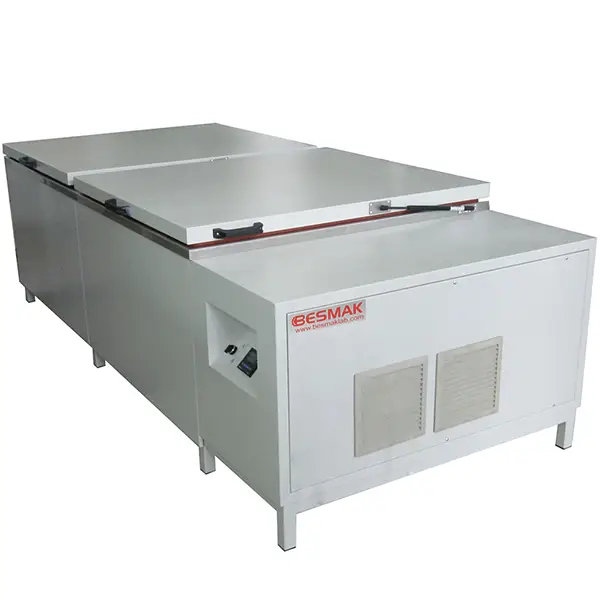
FREEZE – THAW CONCRETE TESTING SYSTEM – BGE-609/7
The Freeze-Thaw Concrete Testing System is designed to evaluate the durability and long-term performance of concrete exposed to repeated freezing and thawing cycles. This advanced testing equipment simulates harsh environmental conditions to determine the resistance of concrete, cementitious materials, and other construction products against frost damage.
The system maintains precise heating and cooling rates, automatically controls freeze-thaw cycles, and enables researchers, laboratories, universities, and quality control departments to perform reliable durability testing in accordance with international standards.
Standards:
- TS EN 12371
- TS 699
- ASTM D6925
What is Freeze-Thaw Concrete Testing?
Freeze-Thaw Concrete Testing is a durability assessment method used to determine how concrete behaves when subjected to repeated freezing and thawing conditions. Water trapped inside the concrete expands during freezing, creating internal pressure that may lead to cracking, scaling, and structural deterioration.
By performing controlled freeze-thaw cycles, engineers can evaluate:
- Concrete durability
- Frost resistance
- Long-term service life
- Material performance in cold climates
- Resistance to environmental deterioration
Features of the Freeze-Thaw Concrete Testing System
The BESMAK Freeze-Thaw Testing System offers advanced control and high accuracy for durability testing applications.
Key Features
- Automatic heating and cooling process control
- Programmable freeze-thaw cycle management
- Automatic cycle counting and test termination
- Adjustable waiting times for water intake and discharge
- Independent water intake tank system
- Flap-top cabinet with piston opening mechanism
- Computer-controlled operation via dedicated software
- Water filling and discharge valve system
- High temperature stability and measurement accuracy
- CE compliant design
Technical Specifications
| Specification | Value |
|---|---|
| Internal Temperature Range | -20°C to +25°C |
| Temperature Accuracy | ±0.1°C |
| Sample Capacity | 300 kg |
| External Dimensions (W×L×H) | 1000 × 750 × 500 mm (+20 mm) |
| Internal Dimensions (W×L×H) | 1000 × 750 × 500 mm (+20 mm) |
| Control System | Computer Controlled |
| Standards Compliance | CE Standards |
Available Models
- BGE-609/7 – Freeze-Thaw Testing System
- BGE-609/2 – Freeze-Thaw Testing System 250 L
- BGE-609/5 – Air Freeze Air Thaw Cabinet
Applications of Freeze-Thaw Concrete Testing
The Freeze-Thaw Concrete Testing System is widely used in:
- Concrete testing laboratories
- Construction material research centers
- Universities and academic institutions
- Infrastructure durability studies
- Transportation and highway projects
- Cement and ready-mix concrete plants
- Quality control laboratories
Applications Include Evaluating
- Concrete freeze-thaw resistance
- Cement-based materials
- High-performance concrete
- Fiber reinforced concrete
- Precast concrete products
- Infrastructure exposed to cold climates
Why Freeze-Thaw Testing is Important
Concrete structures located in cold regions are continuously exposed to freeze-thaw cycles. Without proper durability evaluation, these structures may experience:
- Surface scaling
- Internal cracking
- Strength reduction
- Water penetration
- Premature deterioration
Using a professional Freeze-Thaw Concrete Testing System helps engineers predict material performance and improve concrete mix designs for long-term durability.
Advantages of BESMAK Freeze-Thaw Testing Equipment
- Precise temperature control
- Reliable freeze-thaw cycle simulation
- User-friendly software operation
- Robust industrial construction
- High testing repeatability
- CE compliant manufacturing
- Suitable for research and quality control applications
- Long service life with minimal maintenance
Related Concrete Durability Testing Equipment
For a complete concrete durability laboratory, you can also explore:
- Climate Chamber Testing Systems
- Compression Testing Machines
- Flexural Testing Machines
- Concrete Curing Tanks
- Ultrasonic Pulse Velocity Tester
- Concrete Test Hammer
- Impermeability Test Sets
- Shaking Table Systems
- Linear Variable Differential Transformer (LVDT)
Frequently Asked Questions (FAQ)
What is Freeze-Thaw Concrete Testing?
Freeze-Thaw Concrete Testing evaluates the durability of concrete when subjected to repeated freezing and thawing cycles that simulate harsh environmental conditions.
Why is freeze-thaw resistance important for concrete?
Good freeze-thaw resistance helps prevent cracking, scaling, and premature deterioration in structures exposed to cold weather.
What temperature range does the system provide?
The system operates between -20°C and +25°C with high temperature accuracy.
Who uses Freeze-Thaw Testing Systems?
Universities, research institutions, construction laboratories, concrete manufacturers, and quality control facilities commonly use freeze-thaw testing equipment.
Can the test cycles be programmed?
Yes. The system allows users to define cycle numbers, temperature conditions, water intake, and discharge parameters through software control.
Internal Links
Ultrasonic Pulse Velocity Tester
Concrete Test Hammer
Impermeability Test Sets
Shaking Table System


