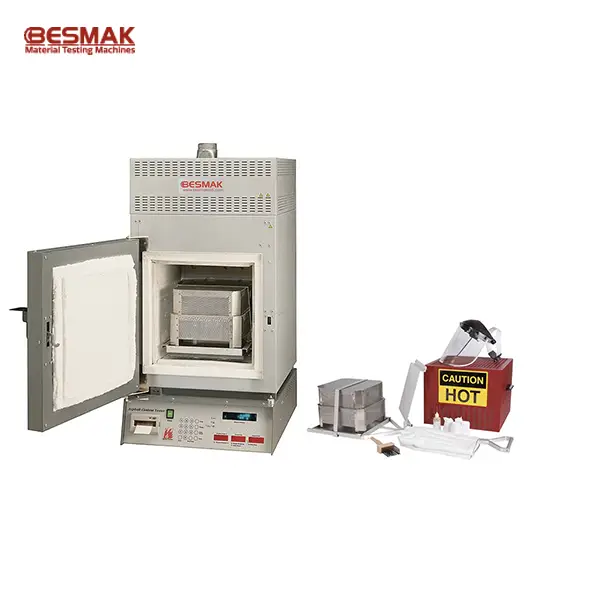
ASPHALT CONCTENT BINDER IGNITION FURNACE (NCAT) – BAS-519
The Asphalt Content Binder Ignition Furnace (NCAT) is designed for fast, accurate and environmentally friendly determination of asphalt binder content using the ignition method. Equipped with an internal automatic balance and advanced safety features, the system complies with ASTM D6307 for asphalt mixture testing.
Standards:
- ASTM D6307
Asphalt Content Binder Ignition Furnace (NCAT) for Asphalt Testing
The Asphalt Content Binder Ignition Furnace (NCAT) is designed to determine the asphalt binder content of asphalt mixtures using the ignition method in accordance with ASTM D6307.
Equipped with an integrated automatic internal balance, the furnace provides a fast, accurate, and environmentally friendly alternative to traditional solvent extraction methods. It accommodates asphalt samples up to 4,000 g, making it ideal for routine laboratory testing, quality control, and research applications.
Key Features
- Integrated automatic internal balance
- Complies with ASTM D6307
- Environmentally friendly ignition method
- Eliminates solvent extraction
- Sample capacity up to 4 kg
- Continuous sample weight monitoring
- Internal balance accuracy: ±0.1 g
- Temperature range: 200–650°C
- Automatic calibration
- Large insulated chamber
- Full 180° opening door
- Software-controlled door safety lock
- Automatic safety interlock
- CE approved
- User-friendly operation
Standards
- ASTM D6307
Technical Specifications
| Specification | Value |
|---|---|
| Standard | ASTM D6307 |
| Maximum Sample Capacity | 4,000 g |
| Temperature Range | 200–650°C |
| Internal Balance Accuracy | ±0.1 g |
| Door Opening | 180° |
| Door Safety Lock | Yes |
| Automatic Safety Interlock | Yes |
| Certification | CE Approved |
How the Asphalt Content Binder Ignition Furnace Works
The Asphalt Content Binder Ignition Furnace determines the asphalt binder content by using the ignition method.
During the test, the asphalt binder is burned from the asphalt mixture while the integrated automatic balance continuously measures the sample weight. Once the ignition cycle is complete, the remaining aggregate weight is automatically calculated, allowing fast, accurate, and repeatable determination of asphalt binder content.
Integrated Automatic Balance System
The furnace features an integrated automatic internal balance that continuously monitors the sample weight throughout the ignition process.
This eliminates the need for manual weighing between test stages, improves repeatability, and minimizes operator error.
Advanced Safety Features
The Asphalt Content Binder Ignition Furnace incorporates multiple safety systems, including:
- Software-controlled door locking
- Automatic safety interlock
- Large insulated chamber
- Full 180° opening door
- Push Start / Stop controls
- User-friendly operating software
These features enhance operator safety while simplifying daily laboratory operation.
Applications of the Asphalt Content Binder Ignition Furnace
The Asphalt Content Binder Ignition Furnace is suitable for:
- Asphalt binder content determination
- Hot Mix Asphalt (HMA) testing
- Asphalt quality control
- Highway construction laboratories
- Pavement engineering laboratories
- Asphalt production plants
- Research laboratories
- University laboratories
Why Choose the BESMAK Asphalt Content Binder Ignition Furnace?
The BESMAK Asphalt Content Binder Ignition Furnace provides fast, accurate, and environmentally friendly determination of asphalt binder content.
Compared with traditional solvent extraction methods, the ignition method significantly reduces testing time, simplifies laboratory procedures, and minimizes environmental impact. Its integrated automatic balance, advanced safety features, and intuitive control system make it an ideal solution for modern asphalt testing laboratories.
Frequently Asked Questions About the Asphalt Content Binder Ignition Furnace
What is an Asphalt Content Binder Ignition Furnace?
An Asphalt Content Binder Ignition Furnace is laboratory equipment used to determine the asphalt binder content of asphalt mixtures by burning off the binder in accordance with ASTM D6307.
Is this an NCAT Ignition Furnace?
Yes. This Asphalt Content Binder Ignition Furnace follows the NCAT ignition testing principle for determining asphalt binder content.
What is the maximum sample capacity?
The furnace can accommodate asphalt samples up to 4,000 g.
What is the weighing accuracy?
The integrated internal balance provides a weighing accuracy of ±0.1 g.
What is the operating temperature range?
The furnace operates within a temperature range of 200°C to 650°C.
Does the furnace require chemical solvents?
No. The ignition method eliminates the need for chemical solvent extraction, making the testing process cleaner and more environmentally friendly.
Is the furnace safe to operate?
Yes. The furnace is equipped with several safety features, including:
- Automatic door safety lock
- Automatic safety interlock
- Large insulated chamber
- Full 180° opening door
Where is the Asphalt Content Binder Ignition Furnace commonly used?
The furnace is widely used in:
- Asphalt testing laboratories
- Highway authorities
- Road construction companies
- Universities
- Research institutes
- Quality control laboratories