
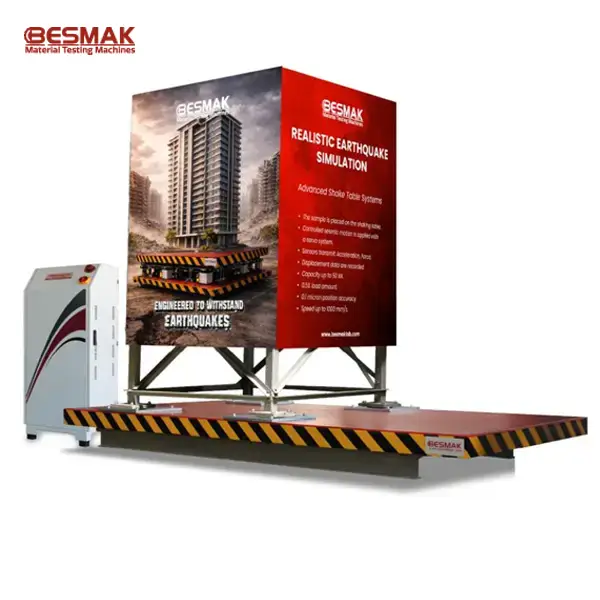
Earthquake Engineering Research
- Used by universities and research institutes to investigate structural behavior under seismic loading conditions.
Building and Bridge Testing
- Evaluates the response of scale models and full-size structures exposed to simulated earthquakes.
Seismic Isolation Testing
- Tests base isolators, bearings, dampers, and other vibration control devices used in earthquake-resistant structures.
Structural Component Testing
- Analyzes the seismic performance of walls, frames, columns, beams, and structural assemblies.
Dynamic Performance Validation
- Supports validation of numerical models and performance-based engineering studies.
Why Choose BESMAK Shaking Table Systems?
More Than 30 Years of Experience
- BESMAK has extensive expertise in material, structural, and seismic testing technologies.
Exported to More Than 75 Countries
- Trusted by laboratories, universities, and industrial organizations worldwide.
Custom-Designed Solutions
- Each Shaking Table System can be tailored according to payload capacity, platform size, motion requirements, and project objectives.
Advanced Dynamic Control Software
- Provides synchronized motion control, data acquisition, monitoring, and reporting capabilities.
Installation, Training and Technical Support
- Complete commissioning, operator training, and after-sales technical support services.
Why Are Shaking Table Systems Important in Earthquake Engineering?
Earthquake engineering requires realistic seismic simulation to evaluate the safety and durability of structures. A Shaking Table System enables engineers and researchers to reproduce real earthquake conditions and validate structural designs before construction.
These systems play a critical role in seismic isolation testing, structural dynamics research, and performance-based earthquake engineering, helping organizations improve safety and reliability in earthquake-prone regions.
Frequently Asked Questions (FAQ)
What is a Shaking Table System?
A Shaking Table System is a dynamic testing platform used to simulate real earthquake motions and evaluate the seismic performance of structures, components, and seismic isolation devices.
What is a Shaking Table used for?
Shaking tables are used for earthquake engineering research, structural dynamics studies, seismic isolation testing, and validation of building and bridge models.
Can a Shaking Table simulate real earthquakes?
Yes. BESMAK Shaking Table Systems can reproduce recorded or user-defined earthquake waveforms with high precision and repeatability.
What industries use Shaking Table Systems?
Universities, research laboratories, civil engineering companies, seismic isolation manufacturers, and government research institutions use shaking tables for seismic testing.
What is the difference between uniaxial and biaxial Shaking Tables?
Uniaxial systems move in one direction, while biaxial systems simulate motion in two directions, providing more realistic earthquake simulation.
Can BESMAK provide custom Shaking Table solutions?
Yes. BESMAK designs custom Shaking Table Systems according to payload capacity, table size, motion requirements, and project specifications.
Request a Quote
Looking for a high-performance Shaking Table System for earthquake simulation and seismic testing?
Contact BESMAK today for expert consultation and a customized solution tailored to your project requirements.
BESMAK – Precision is not optional in material testing.

