

Concrete Cube vs Cylinder Strength: Differences, Conversion and Testing Standards
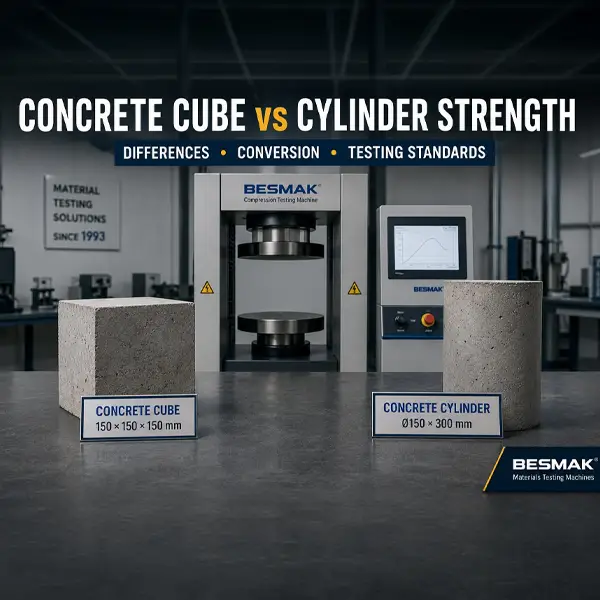
Concrete cube vs cylinder strength is one of the most frequently discussed topics in concrete testing laboratories. Although both specimens are used to determine the compressive strength of concrete, they do not usually produce identical results.
In most cases, a concrete cube reports a higher compressive strength than a cylinder made from the same concrete. This difference is mainly related to specimen geometry, aspect ratio, platen restraint, stress distribution and the testing standard being followed.
Understanding the difference between concrete cube and cylinder strength is essential when comparing test results, interpreting specifications or selecting the correct concrete compression testing equipment.
This guide explains why cube and cylinder results differ, how strength conversion should be approached, which testing standards are commonly used and which factors can influence the final compressive strength result.
What Is Concrete Compressive Strength?
Concrete compressive strength is the ability of hardened concrete to resist compressive loads before failure. It is one of the most important mechanical properties used to evaluate concrete quality and structural performance. During a concrete compressive strength test, a prepared specimen is placed between the loading platens of a compression testing machine. A compressive load is then applied until the specimen fails. The compressive strength is determined from the maximum load carried by the specimen and its loaded cross-sectional area.
The result is commonly expressed in:
- MPa
- N/mm²
- psi
Concrete compressive strength testing is widely used for:
- Quality control
- Concrete mix evaluation
- Structural design verification
- Research and development
- Construction material assessment
- Compliance with project specifications
The specimen used for the test may be a cube or a cylinder depending on the applicable standard, regional practice and project requirements.
What Is a Concrete Cube Test?
A concrete cube test determines the compressive strength of concrete using a cube-shaped specimen.
Common cube dimensions include:
- 100 × 100 × 100 mm
- 150 × 150 × 150 mm
The concrete is placed into a concrete cube mould, compacted according to the applicable procedure and cured under specified conditions. After the required curing period, the specimen is positioned in a compression testing machine and loaded until failure. Cube specimens are widely used in many countries and are commonly associated with European and other international concrete testing practices. The result obtained from the test is reported as concrete cube strength.
What Is a Concrete Cylinder Test?
A concrete cylinder test determines compressive strength using a cylindrical concrete specimen.
Common cylinder dimensions include:
- 100 mm diameter × 200 mm height
- 150 mm diameter × 300 mm height
The height-to-diameter ratio of a standard cylinder is typically 2:1. Cylinder testing is widely used in North America and in testing procedures based on ASTM standards. ASTM C39/C39M is commonly used for determining the compressive strength of cylindrical concrete specimens. During the test, the cylinder is placed centrally between the platens of a compression testing machine and loaded until failure. The result is reported as concrete cylinder compressive strength.
Concrete Cube vs Cylinder Strength: What Is the Main Difference?
The main difference between concrete cube and cylinder strength is that cube specimens generally produce higher compressive strength results than cylinder specimens made from the same concrete. This does not mean that the concrete itself has two different strengths. The difference occurs because the shape and dimensions of the specimen affect how stresses develop during compression testing.
The most important factors include:
- Specimen geometry
- Height-to-width or height-to-diameter ratio
- Friction between the specimen and loading platens
- End restraint
- Stress distribution
- Specimen preparation
- Curing conditions
- Loading procedure
- Testing standard
For this reason, cube and cylinder strength values should not be treated as directly interchangeable without considering the relevant standard and project requirements.
Concrete Cube vs Cylinder: Quick Comparison
- Typical shape: Cube
- Common size: 150 × 150 × 150 mm
- Aspect ratio: 1:1
- Common use: European and international testing practices
- Reported result: Cube compressive strength
- General strength tendency: Usually higher than cylinder strength
- Typical shape: Cylinder
- Common size: 150 mm diameter × 300 mm height
- Height-to-diameter ratio: 2:1
- Common use: ASTM-based and North American testing practices
- Reported result: Cylinder compressive strength
- General strength tendency: Usually lower than cube strength for the same concrete
Why Is Concrete Cube Strength Usually Higher Than Cylinder Strength?
The difference between cube and cylinder strength is mainly caused by specimen geometry and the interaction between the specimen and the compression testing machine. Several factors contribute to the difference.
A cube and a cylinder have different shapes and aspect ratios.
A standard cube has equal height, width and length, while a standard cylinder is typically twice as high as its diameter.
This difference affects how stresses develop and how cracks propagate during loading.
The more compact geometry of a cube generally produces greater apparent resistance during compression testing.
During a compressive strength test, the ends of the specimen are in contact with the loading platens of the testing machine.
Friction at these contact surfaces can restrict lateral expansion near the specimen ends.
Because a cube is shorter relative to its width, a larger proportion of the specimen may be influenced by this restraint.
The taller geometry of a cylinder allows a greater portion of the specimen to deform with less influence from the loading platens.
This is one of the main reasons why cylinder strength is often lower than cube strength.
Specimen geometry affects the internal stress distribution during loading.
In a cylinder, the central region is less influenced by end restraint than in a cube.
As a result, the cylinder may provide a different representation of the concrete’s compressive behavior.
This difference in stress distribution contributes to the variation between cube and cylinder test results.
Cube and cylinder specimens may develop different cracking and failure patterns.
The geometry of the specimen influences:
- Crack initiation
- Crack propagation
- Lateral expansion
- Shear development
- Final failure mode
Correct specimen positioning and uniform loading are essential for obtaining reliable results for both specimen types.
Concrete Cube Strength to Cylinder Strength Conversion
A common question in concrete testing is: how can concrete cube strength be converted to cylinder strength?
A simplified relationship is often used for preliminary comparisons:
Cylinder Strength ≈ 0.8 × Cube Strength
For example, if the cube strength is 50 MPa, the approximate cylinder strength may be estimated as 40 MPa.
However, this relationship should be treated only as an approximate comparison and not as a universal conversion rule.
The actual relationship between cube and cylinder strength may vary depending on:
- Concrete strength level
- Concrete mix composition
- Aggregate characteristics
- Specimen dimensions
- Curing conditions
- Moisture condition at testing
- Specimen preparation
- Loading rate
- Testing machine performance
- Applicable standard
For official test reports, design verification and contractual decisions, laboratories should follow the conversion rules, strength classes and requirements specified by the applicable code or project specification.
Is the Cube-to-Cylinder Conversion Factor Always 0.8?
No. The commonly referenced factor of approximately 0.8 is a simplified general relationship and should not be applied automatically to every concrete test result.
The ratio between cylinder strength and cube strength can change with concrete strength and other testing conditions.
Factors that may affect the relationship include:
- High-strength concrete
- Ultra-high-performance concrete
- Lightweight concrete
- Different aggregate types
- Different specimen sizes
- Different curing histories
- Different testing ages
- Different moisture conditions
Therefore, laboratories should avoid presenting a single conversion factor as universally valid.
Example of Cube and Cylinder Strength Comparison
Consider a concrete mix tested using both cube and cylinder specimens. Cube compressive strength: 50 MPa Approximate cylinder compressive strength using a general 0.8 relationship: 40 MPa This example helps illustrate why two results obtained from the same concrete should not automatically be considered contradictory. The specimen geometry and testing method influence the reported value. However, the estimated value should not replace actual testing or project-specific conversion requirements.
ASTM C39 vs EN 12390-3
ASTM C39/C39M and EN 12390-3 are important standards used in concrete compressive strength testing, but they should not be treated as identical procedures.
ASTM C39/C39M covers the determination of compressive strength of cylindrical concrete specimens.
It is commonly associated with:
- Molded concrete cylinders
- Drilled concrete cores
- ASTM-based testing practices
- Concrete compression testing machines
The standard defines requirements related to the testing procedure and determination of compressive strength for cylindrical specimens.
EN 12390-3 specifies a method for determining the compressive strength of hardened concrete test specimens. It is widely used in European concrete testing practice. The complete testing process may also involve related parts of the EN 12390 series covering specimen dimensions, preparation, curing and testing machine requirements.
Results should be compared carefully.
Differences may exist in:
- Specimen geometry
- Specimen dimensions
- Preparation procedures
- Curing requirements
- Loading procedures
- Result interpretation
A result obtained from a cube should not automatically be treated as equivalent to a result obtained from a cylinder.
The relevant standard and project specification should always be identified before comparing results.
Factors That Affect Concrete Cube and Cylinder Strength Results
Even when the same concrete mixture is used, several testing variables can influence the measured compressive strength.
Different specimen dimensions can influence the measured strength. Laboratories should use specimen sizes permitted by the applicable testing standard and suitable for the concrete being evaluated.
Poor specimen preparation can significantly affect test results.
Possible problems include:
- Incorrect mould filling
- Insufficient compaction
- Excessive compaction
- Damaged specimens
- Irregular dimensions
- Uneven loading surfaces
Concrete strength develops over time and is strongly influenced by curing conditions.
Important factors include:
- Curing temperature
- Moisture availability
- Curing duration
- Specimen storage
- Age at testing
Cube and cylinder results should only be compared when curing histories are properly controlled.
The surfaces in contact with the loading platens should allow the load to be transferred correctly. Irregular or unsuitable end surfaces may create non-uniform stress concentrations and affect the measured strength. Depending on the specimen and applicable standard, suitable end preparation procedures may be required.
The specimen should be correctly centered in the compression testing machine.
Poor alignment may cause eccentric loading and produce:
- Uneven stress distribution
- Premature cracking
- Abnormal failure patterns
- Unreliable test results
The rate at which the load is applied can affect the measured compressive strength. The loading procedure should therefore follow the requirements of the applicable testing standard. A controlled testing machine helps maintain the required loading conditions throughout the test.
Reliable concrete compressive strength testing requires a suitable compression testing machine.
Important machine factors include:
- Correct load capacity
- Accurate force measurement
- Proper platen alignment
- Suitable control system
- Controlled loading
- Calibration capability
- Reliable data acquisition
A machine with unsuitable capacity, poor alignment or inadequate control can affect the reliability of the final result.
How to Perform a Reliable Concrete Compressive Strength Test
Reliable testing requires control of the complete testing process.
Before testing, determine:
- Which standard applies
- Which specimen geometry is required
- Which specimen size should be used
- Which preparation method is required
- Which loading procedure should be followed
The specimen should be produced, compacted and cured according to the relevant procedure.
Avoid:
- Damaged edges
- Irregular dimensions
- Poor compaction
- Uncontrolled curing
- Contaminated loading surfaces
Before placing the specimen in the machine, inspect it for:
- Visible damage
- Surface irregularities
- Incorrect dimensions
- Unsuitable end conditions
Place the specimen centrally in the compression testing machine. Correct positioning helps ensure that the load is applied as uniformly as possible.
The load should be applied using the procedure specified by the applicable standard. The testing system should provide suitable control throughout the test.
The maximum load reached before failure is used to determine compressive strength.
The laboratory should also record relevant information such as:
- Specimen identification
- Specimen dimensions
- Testing age
- Curing history
- Maximum load
- Calculated strength
- Failure observations
- Applicable standard
Reliable concrete compressive strength testing requires a suitable compression testing machine.
Important machine factors include:
- Correct load capacity
- Accurate force measurement
- Proper platen alignment
- Suitable control system
- Controlled loading
- Calibration capability
- Reliable data acquisition
A machine with unsuitable capacity, poor alignment or inadequate control can affect the reliability of the final result.
Common Errors in Concrete Cube and Cylinder Testing
Errors in specimen preparation or machine operation can significantly affect test results.
Common mistakes include:
- Comparing cube and cylinder values as if they were identical
- Using a fixed conversion factor for every concrete type
- Testing specimens with poor surface conditions
- Incorrect specimen centering
- Using unsuitable machine capacity
- Ignoring the required loading procedure
- Comparing specimens with different curing histories
- Failing to inspect abnormal failure patterns
- Using equipment without appropriate calibration
Reducing these errors improves the reliability and repeatability of concrete compressive strength testing.
How to Choose a Compression Testing Machine for Cube and Cylinder Tests
A concrete compression testing machine should be selected according to the specimen type, expected maximum load and applicable testing requirements.
The machine should have sufficient capacity for the expected failure load of the specimens.
The required capacity depends on:
- Specimen dimensions
- Expected concrete strength
- Maximum test load
- Future laboratory requirements
The machine should provide sufficient test space for the intended cube and cylinder dimensions.
Laboratories should verify:
- Vertical clearance
- Platen dimensions
- Specimen access
- Machine frame configuration
Accurate force measurement is essential for reliable compressive strength results. The measurement system should be suitable for the expected test range and applicable accuracy requirements.
The testing system should provide controlled load application according to the required test procedure. Automatic or servo-controlled systems can help improve consistency and reduce operator-dependent variation.
Modern concrete compression testing systems may provide:
- Real-time test monitoring
- Automatic data acquisition
- Test result calculation
- Data storage
- Test reports
- Exportable results
These features can improve laboratory efficiency and traceability.
Cube or Cylinder: Which Specimen Should a Laboratory Use?
The correct specimen type depends primarily on the applicable standard and project requirements.
Use the specimen required by:
- The project specification
- The national code
- The testing standard
- The client requirement
- The laboratory quality procedure
A laboratory should not choose a cube or cylinder simply because one specimen produces a higher or lower result.
The purpose of standardized testing is to obtain results that can be interpreted consistently within the correct technical framework.
Can the Same Compression Testing Machine Test Both Cubes and Cylinders?
In many cases, yes.
A suitable concrete compression testing machine can often test both cube and cylinder specimens if:
- The machine has sufficient load capacity
- The test space accommodates both specimen types
- The platen configuration is suitable
- The required loading procedure can be controlled
- The system meets the applicable testing requirements
Before selecting a machine, laboratories should identify all specimen sizes, expected strength ranges and standards they plan to use.
Why Reliable Compression Testing Equipment Matters
The quality of a concrete compressive strength result depends on more than the concrete specimen.
Reliable testing also requires:
- Correct specimen preparation
- Controlled curing
- Proper specimen positioning
- Suitable loading surfaces
- Accurate force measurement
- Controlled load application
- Appropriate calibration
- Correct data recording
For this reason, the compression testing machine is an important part of the complete measurement system.
BESMAK develops material testing equipment and concrete testing systems for laboratories, universities, research centers and industrial applications.
The correct testing system should always be configured according to specimen type, expected load range, applicable standard and laboratory requirements.
Conclusion
Understanding Concrete Cube vs Cylinder Strength
Concrete cube and cylinder tests are both widely used to evaluate the compressive strength of hardened concrete, but their results should not be expected to be identical.
Cube strength is generally higher than cylinder strength because specimen geometry, aspect ratio, platen restraint and stress distribution influence the test result.
A general conversion relationship may be useful for preliminary comparison, but no single conversion factor should be treated as universally valid for every concrete type and strength level.
For reliable results, laboratories should:
- Follow the applicable testing standard
- Use the correct specimen geometry
- Control specimen preparation and curing
- Position specimens correctly
- Apply the required loading procedure
- Use suitable and calibrated compression testing equipment
Understanding the difference between concrete cube vs cylinder strength helps engineers and laboratory professionals interpret results correctly and avoid misleading comparisons between different testing methods.
Frequently Asked Questions About Concrete Cube vs Cylinder Strength
Concrete cube strength is generally higher because the shorter cube geometry is more strongly influenced by restraint and friction at the loading platens. Specimen geometry and stress distribution affect the apparent compressive strength.
A simplified relationship of cylinder strength being approximately 0.8 times cube strength is often used for general comparison. However, the actual relationship varies, and the applicable code or project specification should be followed.
A universal direct conversion is not recommended. The relationship depends on concrete strength, specimen dimensions, curing conditions, materials and the applicable standard.
ASTM C39/C39M covers compressive strength testing of cylindrical concrete specimens. EN 12390-3 specifies a method for determining the compressive strength of hardened concrete test specimens.
Neither specimen is universally better. The correct choice depends on the applicable testing standard, national practice and project specification.
Yes, in many cases. The machine must have suitable capacity, test space, platen configuration, force measurement and loading control for the required specimens and standards.
Important factors include specimen geometry, size, preparation, curing, age, end condition, alignment, loading procedure and testing machine performance.
Calibration helps verify that the force measurement system performs within the required accuracy range. Reliable force measurement is essential for trustworthy compressive strength results.