
Fatigue Testing Machine: Complete Technical Guide for Engineers and Laboratories
Fatigue failure is one of the most common causes of unexpected component breakdown in aerospace, automotive, medical, and structural applications. A fatigue testing machine helps engineers simulate millions of loading cycles and predict the real service life of materials and components before they fail in the field.
In this comprehensive guide, you will learn:
- What a fatigue testing machine is
- How a fatigue testing machine works
- Main types of fatigue testing machines
- International testing standards
- Industrial applications
- Key specifications to consider before buying
- Frequently asked questions
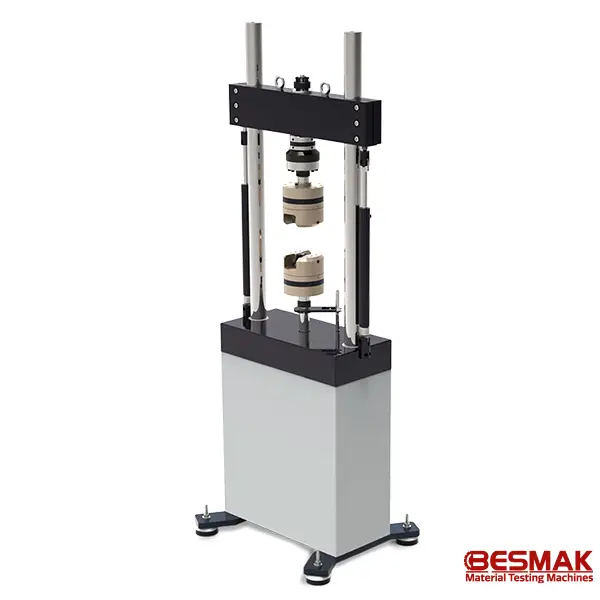
What Is a Fatigue Testing Machine?
A fatigue testing machine is a specialized material testing system used to apply repeated cyclic loads to a specimen in order to determine its fatigue life, endurance limit, crack initiation behavior, and crack growth characteristics.
Unlike a conventional universal testing machine, a fatigue testing machine can generate thousands to millions of load cycles under precisely controlled conditions.
Definition of Fatigue Testing
Fatigue testing evaluates how a material behaves when subjected to repeated stress over time.
Typical outputs include:
- Number of cycles to failure (Nf)
- Stress-life (S-N) curves
- Strain-life (ε-N) curves
- Crack growth rate (da/dN)
- Hysteresis loops
- Endurance limit
Why Is Fatigue Testing Important?
Fatigue is a major cause of failure in components subjected to repeated or cyclic loading.
Fatigue testing helps manufacturers:
- Predict product lifetime
- Prevent catastrophic failures
- Improve safety
- Meet certification requirements
- Reduce warranty costs
- Optimize material selection
How Does a Fatigue Testing Machine Work?
A fatigue testing machine repeatedly applies controlled tension, compression, bending, or torsion loads to a specimen until failure occurs or a predefined cycle count is reached.
Specimen Preparation
Specimens are manufactured according to standards such as ASTM E466 or ISO 1099.
Fixture Installation
The specimen is mounted using grips or fixtures.
Test Programming
Parameters are defined, including:
- Maximum load
- Minimum load
- Stress ratio (R)
- Frequency
- Number of cycles
- Waveform (sine, triangle, square)
Cyclic Loading
The actuator applies repeated loads with high accuracy.
Failure Detection and Reporting
Software records cycles to failure and generates complete reports.
Load Frame
Provides structural rigidity and alignment.
Servo Hydraulic Actuator
Generates dynamic loading.
Load Cell
Measures force with Class 0.5 accuracy.
Extensometer and LVDT
Measures strain and displacement.
Digital Controller
Maintains closed-loop control.
Testing Software
Creates methods, monitors data, and generates reports.
Types of Fatigue Testing Machines
Servo Hydraulic Fatigue Testing Machine
Best for high-force and versatile applications.
Electrodynamic Fatigue Testing Machine
Suitable for smaller and higher-frequency tests.
Rotating Bending Fatigue Testing Machine
Used for shafts and cylindrical specimens.
Torsional Fatigue Testing Machine
Applies cyclic torque.
Multiaxial Fatigue Testing Machine
Combines axial, torsional, and bending loads.
Fatigue Testing Machine Applications
Fatigue testing machines are used in:
- Aircraft structures
- Automotive suspension components
- Orthopedic implants
- Composite materials
- Springs and fasteners
- Welded joints
- Rubber products
- Structural connections
Materials Commonly Tested
- Steel
- Aluminum
- Titanium
- Nickel alloys
- Carbon fiber composites
- Plastics
- Elastomers
- Ceramics
Key Fatigue Test Methods
High Cycle Fatigue (HCF)
Millions of cycles at lower stress.
Low Cycle Fatigue (LCF)
- High strain with fewer cycles.
Very High Cycle Fatigue (VHCF)
Beyond 10⁷ cycles.
Crack Growth Testing
Measures propagation rates.
Thermo-Mechanical Fatigue (TMF)
Combines cyclic loading and temperature.
International Standards for Fatigue Testing
- ASTM E466
- ASTM E606
- ASTM E647
- ASTM D3479
- ISO 1099
- ISO 12106
How to Choose the Best Fatigue Testing Machine
Load Capacity
Select based on maximum force requirements.
Frequency Range
Higher frequencies reduce test duration.
Control Modes
Load, displacement, and strain control.
Environmental Compatibility
Temperature chambers and corrosion cells.
Software and Automation
Method creation and advanced analysis.
Service and Support
Calibration, training, and spare parts.
Servo Hydraulic vs Electrodynamic Fatigue Testing Machines
| Feature | Servo Hydraulic | Electrodynamic |
|---|---|---|
| Load Capacity | Very High | Low to Medium |
| Frequency | Moderate to High | Very High |
| Versatility | Excellent | Good |
| Large Specimen Testing | Yes | Limited |
| Environmental Testing | Excellent | Moderate |
Typical Technical Specifications
Capacity: 0.25 kN to 1000 kN
Accuracy: ISO 7500-1 Class 0.5
Control Modes: Load, displacement, strain
Frequency: Up to application-specific ranges
Waveforms: Sine, triangle, square
Data Acquisition: Multi-channel
Common Questions Engineers Ask
What is a fatigue testing machine?
A machine used to determine how long a material survives under repeated cyclic loading.
How does a fatigue testing machine work?
It applies cyclic loads and records cycles to failure.
Which industries use fatigue testing machines?
Aerospace, automotive, medical, construction, and research.
Which standards are used?
- ASTM E466
- ASTM E606
- ASTM E647
- ISO 1099
- ISO 12106.
What is the difference between static and fatigue testing?
Static testing applies load once; fatigue testing repeats the load millions of times.
Why Laboratories Choose BESMAK Fatigue Testing Machines
BESMAK designs and manufactures advanced servo hydraulic fatigue testing machines for universities, research centers, and industrial laboratories worldwide.
Key advantages:
- 30+ years of engineering experience
- Export to 75+ countries
- Capacities from 0.25 kN to 1000 kN
- ISO 7500-1 Class 0.5 accuracy
- Custom grips and fixtures
- Global technical support
Final Thoughts
A fatigue testing machine is essential for evaluating durability, predicting service life, and preventing unexpected failures. A technically detailed, well-structured guide like this can rank for informational searches and attract engineers who are actively researching fatigue testing solutions.