
How Does a Tensile Testing Machine Work?
A tensile testing machine is one of the most important systems used in material testing laboratories to measure the mechanical properties of materials under tension. Industries such as construction, automotive, aerospace, metal production, and research laboratories use tensile testing machines to evaluate material strength, elongation, deformation, and structural performance.
Modern testing systems provide highly accurate force control and real-time data analysis to ensure reliable testing results for quality control and research applications.
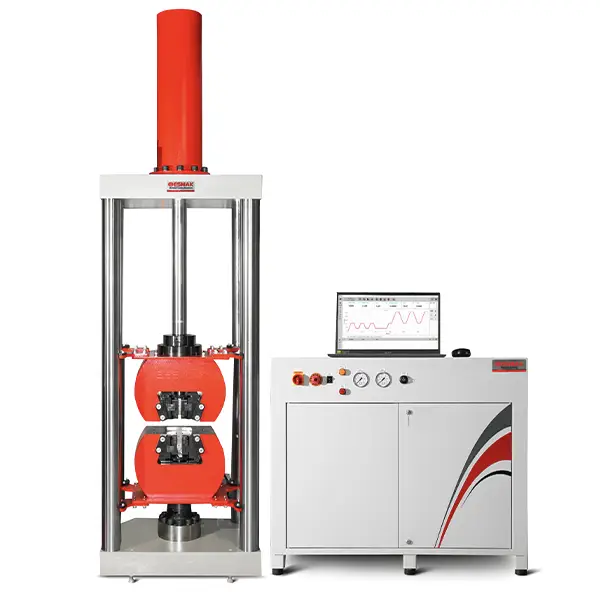
What is a Tensile Testing Machine?
A tensile testing machine is a universal testing system designed to apply controlled tensile force to a material specimen until deformation or fracture occurs. During the test, the machine measures important mechanical properties such as:
- Tensile strength
- Yield strength
- Elongation
- Young’s modulus
- Maximum load capacity
- Material deformation behavior
The testing process helps engineers and manufacturers determine whether a material meets required quality and safety standards.
How Does a Tensile Testing Machine Work?
A tensile testing machine works by gripping a test specimen between two hydraulic or mechanical grips and applying controlled pulling force along the material’s longitudinal axis.
The machine continuously measures force and displacement while recording test data in real time
Specimen Placement
The test specimen is securely mounted between the upper and lower grips of the tensile testing machine.
Proper specimen alignment is critical for achieving accurate and repeatable test results.
Applying Tensile Force
The machine begins applying tensile load through a servo hydraulic or electromechanical actuator system. The load increases gradually according to the selected testing standard and test speed.
Monitoring Material Deformation
As the force increases, the material begins to elongate. Advanced sensors and extensometers measure strain, displacement, and deformation during the test cycle.
Recording Test Data
The testing software continuously records:
- Load values
- Displacement
- Stress-strain curves
- Elongation data
- Maximum force values
This data is used for detailed material analysis and quality control reporting.
Understanding the Stress-Strain Curve in Tensile Testing
During a tensile test, the testing system records force and deformation data as the specimen is continuously loaded. These measurements can be converted into stress and strain values to generate a stress-strain curve.
The stress-strain curve provides important information about material behavior, including:
- Elastic behavior
- Yield strength
- Ultimate tensile strength
- Plastic deformation
- Elongation
- Fracture behavior
For accurate strain measurement, tensile testing systems can use contact extensometers or advanced non-contact measurement technologies such as video extensometers.
Common Tensile Testing Standards
Tensile testing procedures vary according to material type and application. International standards define requirements such as specimen geometry, test speed, strain measurement and reporting.
Common tensile testing standards include:
- ASTM E8/E8M – Tensile testing of metallic materials
- ISO 6892-1 – Tensile testing of metallic materials at room temperature
- ASTM D638 – Tensile properties of plastics
- ISO 527 – Tensile properties of plastics
Laboratories should always select the testing procedure, grips, extensometer and machine configuration according to the applicable standard and specimen requirements.
Material Failure Analysis
The test continues until the specimen fractures or reaches the required test limit. Engineers analyze the collected data to determine the material’s mechanical performance.
Main Components of a Tensile Testing Machine
A modern tensile testing machine includes several important components that ensure accurate and stable testing performance.
Load Frame
The rigid load frame provides structural stability during high-force testing procedures.
Hydraulic or Electromechanical Actuator
The actuator applies controlled tensile force to the specimen during the test.
Load Cell
The load cell measures applied force with high precision and repeatability.
Extensometer
An extensometer measures strain and elongation values throughout the testing process.
Universal Testing Software
The software controls the testing procedure, records live data, generates graphs, and creates professional test reports
Why is Tensile Testing Important?
Tensile testing is essential for evaluating material reliability, product safety, and compliance with international standards.
Industries use tensile testing to:
- Verify product quality
- Compare material performance
- Improve product durability
- Ensure safety compliance
- Support research and development
- Validate manufacturing consistency
Without accurate tensile testing, manufacturers may face structural failures, quality issues, and safety risks.
Types of Tensile Testing Machines
Different industries use different types of tensile testing machines depending on testing requirements.
Servo Hydraulic Tensile Testing Machine
Servo hydraulic systems provide high-force capacity and excellent control for heavy-duty industrial applications.
Electromechanical Tensile Testing Machine
Electromechanical systems offer precise low-speed control and are commonly used for research laboratories and sensitive materials.
Universal Testing Machine (UTM)
Universal testing machines can perform tensile, compression, flexural, and other mechanical tests within a single system.
Applications of Tensile Testing Machines
A tensile testing machine is widely used in:
- Steel and metal testing
- Construction material testing
- Automotive industry
- Aerospace engineering
- Plastic and polymer testing
- Composite material analysis
- Research laboratories
- Industrial quality control
Choosing the Right Tensile Testing Machine
Selecting the right tensile testing machine depends on several factors:
- Required testing capacity
- Material type
- Accuracy requirements
- Testing standards
- Extensometer compatibility
- Software capabilities
- Laboratory workload
Modern laboratories prefer advanced testing systems with intelligent automation, high precision, and flexible testing configurations.
Why Choose BESMAK Tensile Testing Machines?
BESMAK develops advanced tensile testing machines designed for reliable, accurate, and repeatable material testing applications. With high-precision load control, intelligent testing software, and robust structural design, BESMAK systems support modern laboratory requirements worldwide.
What does a tensile testing machine measure?
It measures tensile strength, elongation, yield strength, deformation, and other mechanical properties of materials.
How accurate are tensile testing machines?
Modern tensile testing machines provide highly accurate measurements using advanced load cells and electronic control systems.
What industries use tensile testing machines?
Construction, automotive, aerospace, manufacturing, research laboratories, and metal industries commonly use tensile testing systems.
What is the difference between hydraulic and electromechanical tensile testing machines?
Hydraulic systems are ideal for high-force industrial applications, while electromechanical systems provide more precise low-speed control for sensitive materials.