

How to Select the Right Cement Compression and Flexural Testing Machine
Selecting the right cement compression and flexural testing machine is one of the most important decisions for any laboratory involved in cement quality control. Whether you operate a cement manufacturing plant, an independent testing laboratory, a university research center, or a construction materials laboratory, choosing the correct testing equipment directly impacts the accuracy, repeatability, and reliability of your test results.
Modern cement laboratories require equipment that complies with international standards, delivers precise load control, and offers advanced software for efficient testing. This guide explains the key factors to consider before purchasing a cement testing machine.
Why Choosing the Right Cement Testing Machine Matters
Accurate cement testing ensures that construction materials meet the required mechanical properties before being used in real-world applications.
A high-quality cement testing machine helps laboratories:
- Produce reliable test results
- Meet international quality standards
- Improve laboratory efficiency
- Reduce operator errors
- Increase testing repeatability
- Support accreditation requirements
- Ensure long-term equipment reliability
Investing in the right equipment also reduces maintenance costs and improves productivity over the lifetime of the machine.
Understand Your Testing Requirements
Before selecting a machine, laboratories should identify the types of tests they perform.
Typical cement tests include:
- Cement Compression Test
- Cement Flexural Strength Test
- Mortar Strength Test
- Quality Control Testing
- Research and Development Testing
Many laboratories prefer machines capable of performing both compression and flexural tests using interchangeable fixtures, eliminating the need for separate testing systems.
Check International Standards Compliance
Compliance with recognized international standards is essential for producing valid and accepted test results.
Choose equipment that complies with standards such as:
- EN 196-1
- ASTM C109
- ASTM C348
- ASTM C349
- ISO 679
- BS 3892-1
- EN 459-2
- ASTM C1609
- EN 13459-2
Machines supporting multiple standards provide greater flexibility for laboratories serving international customers.
Select the Appropriate Load Capacity
Load capacity should match your laboratory’s testing requirements.
Common capacities include:
Capacity Typical Application
- 100 kN-Small laboratories
- 150 kN-Routine quality control
- 200 kN-Industrial laboratories
- 250 kN-High-volume testing
- 300 kN-Research and advanced laboratories
Choosing excessive capacity may increase costs unnecessarily, while insufficient capacity limits future testing capabilities.
Servo-Electromechanical or Hydraulic?
Many laboratories now prefer servo-electromechanical cement testing machines because they offer:
- Higher positioning accuracy
- Smooth loading control
- Lower maintenance
- Reduced energy consumption
- Cleaner laboratory operation
- Better repeatability
- Quieter testing environment
Hydraulic machines remain suitable for certain heavy-duty applications, but servo-electromechanical systems provide excellent performance for most cement laboratories.
Evaluate the Control System
The controller is the brain of the testing machine.
Look for features such as:
- Closed-loop control
- Automatic calibration
- Adjustable loading rate
- High-speed data acquisition
- Multi-channel controller
- Elastic modulus calculation
- User-friendly interface
Modern controllers significantly improve testing accuracy and reduce operator dependency.
Software Makes a Difference
Testing software should simplify daily laboratory work.
Essential software features include:
- Automatic test procedures
- Live load-displacement graphs
- Test report generation
- Export to Excel and PDF
- Operator management
- Database storage
- Custom test methods
- Standards-based testing procedures
Industrial touchscreen interfaces also improve usability and reduce training time.
Consider Future Expansion
Laboratories often expand their testing capabilities over time.
Choose equipment that supports optional accessories such as:
- Compression Fixtures
- Flexural Fixtures
- Load Cells
- Electronic Control Units
- Additional Sensors
- Industrial Touch Panels
A modular system allows future upgrades without replacing the entire machine.
Why BESMAK Cement Testing Machines?
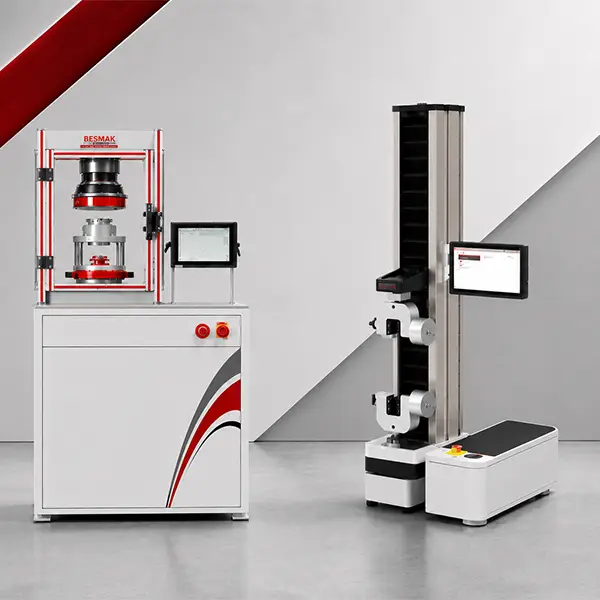
BESMAK designs and manufactures advanced cement testing equipment for laboratories worldwide.
Key advantages include:
- Servo-electromechanical technology
- Capacities from 100–300 kN
- Compression and flexural testing in one system
- 12-channel digital controller
- Linux-based industrial touchscreen
- Automatic calibration
- High-precision load measurement
- Compliance with EN, ASTM, ISO, and BS standards
- Exported to more than 75 countries
- Over 30 years of experience in material testing equipment manufacturing
Final Thoughts
Choosing the right cement compression and flexural testing machine is an investment in laboratory quality, productivity, and long-term reliability. Laboratories should carefully evaluate testing requirements, international standards, software capabilities, control systems, and future expansion possibilities before making a purchasing decision.
A modern servo-electromechanical testing machine provides greater precision, easier operation, and higher efficiency while ensuring compliance with internationally recognized testing standards.
Frequently Asked Questions
It is a laboratory testing system used to determine the compressive and flexural strength of cement mortar specimens according to international standards.
Most laboratories use machines between 100 kN and 300 kN, depending on testing volume and application requirements.
Servo-electromechanical systems provide higher precision, lower maintenance, smoother loading control, and better energy efficiency than many traditional hydraulic systems.
Common standards include EN 196-1, ASTM C109, ASTM C348, ASTM C349, ISO 679, BS 3892-1, EN 459-2, ASTM C1609, and EN 13459-2.
Yes. Many modern cement testing machines use interchangeable fixtures to perform both tests on a single system.