
What is a Video Extensometer?
A video extensometer is a critical tool for modern material testing laboratories. This advanced system measures deformation and strain values during testing in a completely contactless manner. In contrast, traditional clip-on devices must physically attach to the specimen. However, video extensometers perform measurements entirely remotely. As a result, this method protects the specimen and increases measurement accuracy. Additionally, advanced image processing algorithms analyze deformation in real time..
How Does a Video Extensometer Work?
During testing, the system continuously tracks the surface of the specimen. Specifically, it converts any physical changes into digital data. In this context, Digital Image Correlation (DIC) technology plays a key role in the process.
Working Principle
Initially, the system defines the specimen surface as a reference point. Once the load is applied, it begins monitoring micro-level changes using a high-resolution camera. Subsequently, the captured images are processed rapidly to generate precise strain data. Consequently, the measurement process remains completely non-contact. Therefore, laboratories can achieve a much higher level of accuracy and repeatability.
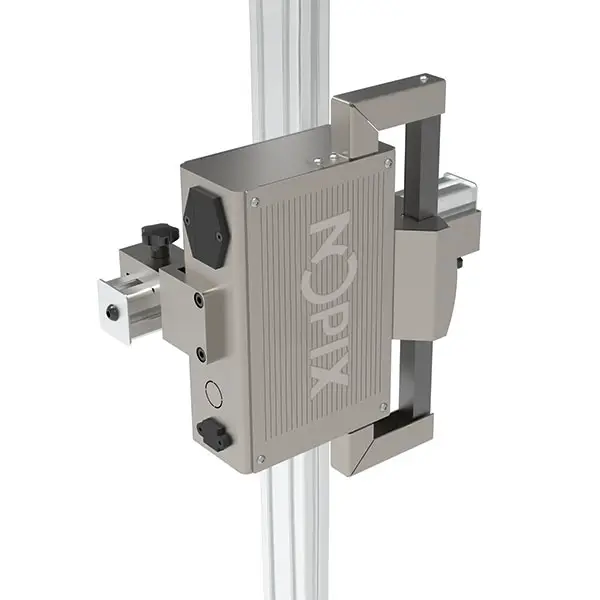
BMT-EV Nopix Video Extensometer
Developed by BESMAK®, the BMT-EV Nopix is a modern solution for contactless strain measurement. This system delivers high performance across tensile and compression tests. Furthermore, the device monitors the entire process without any physical interaction. Because it provides real-time data output, operator-related errors are minimized. For this reason, it serves as a reliable alternative where traditional devices fall short.
Features of the BMT-EV Video Extensometer
The BMT-EV Nopix video extensometer stands out due to its advanced technical capabilities. Moreover, its key features include:
- First, it performs contactless measurement based on DIC technology.
- Second, it collects data at a high speed of 75–200 Hz.
- Third, the system measures both axial and transverse deformation.
- In addition, it detects necking automatically during the test.
- Finally, the device fully complies with ISO 9513 and ASTM standards.
Why Choose a Contactless Extensometer?
In some cases, conventional extensometers may damage the specimen. In contrast, video extensometers eliminate this risk entirely. Since no physical contact is applied, the specimen remains untouched. Additionally, a single system can be used for many different test types. As a result, testing processes become much more efficient and reliable.
Conclusion
Overall, video extensometers play a central role in modern material analysis. In particular, the BMT-EV Nopix stands out with its high accuracy. Therefore, it is an ideal choice for laboratories aiming to obtain consistent results.
Click to explore the product in detail: BMT-EV Nopix Page