

What Is Seismic Isolation and How Does It Protect Buildings During Earthquakes?
Earthquakes can cause severe structural damage and loss of life. One of the most effective technologies developed to reduce this risk is seismic isolation, also known as base isolation. This engineering technique separates a structure from ground motion, significantly reducing the forces transmitted to the building.
In this article, we explain how seismic isolation works, the types of base isolators, their advantages, and why laboratory testing is essential for verifying performance.
What Is Seismic Isolation?
Seismic isolation is a structural design approach that decouples a building from ground movement during an earthquake. Flexible and energy-dissipating devices, called base isolators, are installed between the building and its foundation.
These devices:
- Reduce acceleration transmitted to the structure
- Minimize inter-story drift
- Protect structural and non-structural components
- Improve occupant safety
How Does Base Isolation Help During an Earthquake?
When the ground shakes, conventional buildings move with the soil. In contrast, base-isolated structures can move independently.
Reduced Structural Acceleration
The isolators absorb and dissipate seismic energy, reducing the forces acting on the superstructure.
Increased Natural Period
Base isolation increases the building’s vibration period, shifting it away from damaging frequency ranges.
Lower Damage to Equipment and Contents
Hospitals, laboratories, and data centers benefit greatly because sensitive equipment remains operational.
What Happens to a Base-Isolated Building During an Earthquake?
A base-isolated building may move several hundred millimeters at its foundation while the upper structure remains relatively stable.
Benefits include:
- Reduced cracking and structural damage
- Improved functionality after the earthquake
- Lower repair costs
- Enhanced safety for occupants
Types of Seismic Isolation Systems
Lead Rubber Bearings (LRB)
Rubber layers with a lead core that provide both flexibility and damping.
High Damping Rubber Bearings (HDRB)
Special rubber compounds that dissipate energy without a lead core.
Friction Pendulum Bearings (FPB)
Use sliding surfaces to control movement and re-center the structure.
Where Is Seismic Isolation Used?
Seismic isolation is widely used in:
- Hospitals
- Bridges
- Airports
- Nuclear facilities
- Historic buildings
- Emergency response centers
Does Freedom Tower Have Seismic Isolation?
Some landmark structures incorporate advanced vibration control systems, although the specific approach depends on local seismic risk and design objectives.
How Do Base Isolators Reduce Earthquake Damage?
Base isolators:
- Decouple the structure from the ground
- Lengthen the natural period
- Dissipate seismic energy
- Reduce transmitted acceleration
- Limit structural stress
Why Testing Seismic Isolation Devices Is Essential
Before installation, isolators must be tested to ensure compliance with international standards and design requirements.
Typical tests include:
- Vertical compression
- Horizontal cyclic displacement
- Combined loading
- Fatigue testing
- Long-stroke performance
Standards for Seismic Isolation Testing
Common standards include:
- EN 15129
- AASHTO
- ISO 22762
- ASCE 7
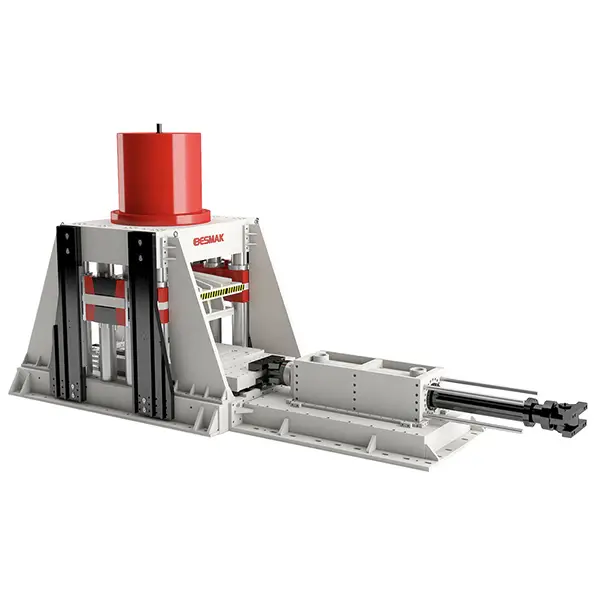
BESMAK Earthquake Isolation Test Machine
The BESMAK Earthquake Isolation Test Machine is designed for advanced testing of seismic bearings and dampers under realistic loading conditions.
Key capabilities:
- Vertical capacity up to 30,000 kN
- Horizontal capacity up to 3,500 kN
- Cyclic and dynamic loading
- Non-contact displacement measurement
- Compliance with EN 15129 and EN 1337
Key Features of an Earthquake Isolation Test System
Multi-Axial Loading
Simultaneous vertical and horizontal forces.
Long Stroke Actuators
Large displacements to replicate earthquake motion.
Closed-Loop Control
Precise control of force, displacement, and frequency.
Advanced Data Acquisition
High-speed recording and analysis.
Benefits of Seismic Isolation Technology
- Protects lives and critical infrastructure
- Reduces repair and downtime costs
- Maintains operational continuity
- Extends structural service life
Frequently Asked Questions About Seismic Isolation
What is seismic isolation?
A method of separating a structure from ground motion using flexible bearings.
How does base isolation help during an earthquake?
It reduces the seismic forces transferred to the building.
What happens to a base-isolated building during an earthquake?
The foundation moves while the upper structure remains comparatively stable.
How do base isolators reduce earthquake damage?
By dissipating energy and limiting transmitted acceleration.
Why is testing important?
Testing verifies performance and compliance with standards.
Conclusion
Seismic isolation is one of the most effective technologies for protecting buildings and infrastructure from earthquakes. Proper testing of isolators and dampers is essential to ensure reliable performance under real seismic conditions.
For laboratories and research institutions seeking a high-capacity testing solution, BESMAK offers advanced earthquake isolation test systems engineered for precision and compliance.