

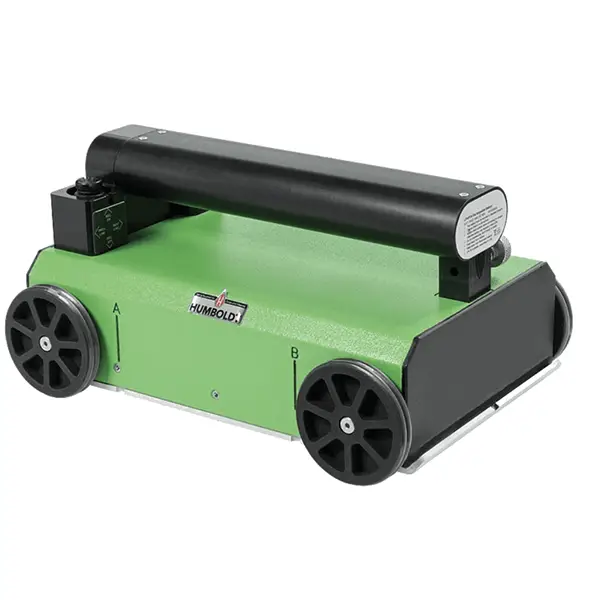
CONCRETE GPR SCANNER FOR REBAR, VOID AND UTILITY DETECTION – BCO-H/HC-6100B.3F
The Concrete GPR Scanner is an advanced non-destructive testing (NDT) solution designed for locating rebar, conduits, pipes, cables, voids, and other embedded objects within concrete structures. Utilizing high-frequency Ground Penetrating Radar (GPR) technology, the system delivers high-resolution subsurface imaging while maintaining excellent penetration depth.
The scanner is ideal for structural inspections, bridge assessments, building investigations, infrastructure maintenance, utility mapping, and concrete rehabilitation projects. Its wireless design, integrated positioning systems, and powerful data visualization software provide engineers and inspectors with accurate and reliable results in the field.
Key Features of the Concrete GPR Scanner
- High-resolution Ground Penetrating Radar technology
- Dual-frequency antenna system for optimized depth and accuracy
- Detects rebar, conduits, cables, pipes, voids, and embedded utilities
- Wireless communication via Wi-Fi
- Rugged IP65-rated construction for field applications
- Integrated odometer and GPS positioning
- Optional inertial measurement unit (IMU)
- Real-time data acquisition and visualization
- Fast scanning of floors, walls, bridges, tunnels, and concrete structures
- Advanced software for B-Scan, depth slice, and 3D imaging analysis
Applications of Concrete GPR Scanning
Concrete GPR technology is widely used for:
Rebar Detection and Mapping
Accurately locate reinforcing bars before drilling, coring, cutting, or structural modifications.
Utility and Conduit Detection
Identify electrical conduits, post-tension cables, pipes, and embedded services within concrete elements.
Void Detection
Locate air pockets, delaminations, honeycombing, and hidden voids in concrete structures.
Structural Investigation
Evaluate existing structures without causing damage to concrete surfaces.
Infrastructure Inspection
Used in bridges, tunnels, parking structures, airports, dams, and transportation projects.
Technical Specifications
Radar System
- 2 GHz bi-static radar antenna
- 750 MHz bi-static radar antenna
- High-resolution scanning capability
- Excellent penetration depth for concrete applications
Positioning System
- Odometer-based positioning
- Integrated GPS capability
- Optional inertial measurement system
Communication
- Wireless Wi-Fi communication
- Rugged tablet integration
- Remote data collection and analysis
Environmental Protection
- IP65 ingress protection
- Durable field-ready construction
- Designed for demanding jobsite conditions
Advanced Data Visualization
The Concrete GPR Scanner includes powerful software that transforms collected radar data into clear and actionable information.
The software supports:
- B-Scan imaging
- Cross-sectional analysis
- Depth slice visualization
- Three-dimensional (3D) imaging
- Real-time data interpretation
- Comprehensive reporting capabilities
These features allow engineers to make informed decisions regarding structural safety, maintenance planning, and rehabilitation strategies.
Why Choose BESMAK Concrete GPR Scanner?
BESMAK provides advanced testing and inspection solutions trusted by laboratories, engineering firms, contractors, universities, and research institutions worldwide.
Benefits include:
- Reliable and accurate detection technology
- Fast scanning speeds
- High-resolution subsurface imaging
- User-friendly software interface
- Durable field operation
- Technical support and training
- Compliance with international testing and inspection practices
Related Concrete Testing Equipment
To create a complete concrete inspection and evaluation laboratory, the Concrete GPR Scanner can be used together with:
- Profometer Rebar Diameter and Cover Meter
- Resipod Concrete Resistivity Meter
- Ultrasonic Pulse Velocity Tester
- Concrete Test Hammer
- Concrete Crack Gauge
- Crack Measuring Microscope
- Pullout Test Apparatus
- Compression Testing Machine
- Concrete Testing Equipment
Internal Links
- Concrete Testing Equipment
- Profometer Rebar Diameter and Cover Meter
- Resipod Concrete Resistivity Meter
- Ultrasonic Pulse Velocity Tester
- Concrete Test Hammer
- Concrete Crack Gauge
- Crack Measuring Microscope
- Pullout Test Apparatus
- Compression Testing Machine
Frequently Asked Questions (FAQ)
What is a Concrete GPR Scanner?
A Concrete GPR Scanner is a Ground Penetrating Radar system used to detect and map rebar, conduits, pipes, voids, and other embedded objects inside concrete without damaging the structure.
How deep can a Concrete GPR Scanner detect objects?
Detection depth depends on material properties, object size, and antenna frequency. High-frequency antennas provide excellent resolution for typical concrete inspection applications.
Can GPR detect rebar in concrete?
Yes. Concrete GPR technology is widely used to locate reinforcing bars, determine spacing, and map reinforcement layouts before drilling or cutting operations.
Is Concrete GPR testing non-destructive?
Yes. Ground Penetrating Radar is a completely non-destructive testing method that does not damage concrete structures.
What industries use Concrete GPR Scanners?
Construction, infrastructure, transportation, civil engineering, structural inspection, forensic engineering, utilities, and research laboratories commonly use Concrete GPR systems.
Request a Quote
Looking for a reliable Concrete GPR Scanner for rebar detection, utility mapping, void identification, and structural investigation?
Contact BESMAK today for technical information, pricing, and expert support for your concrete inspection projects.
Related products
-

CONCRETE MODULDS FOR ACCURATE CONCRETE SPEIMEN PREPARATION – BCO-120
Read more -

COMPACTION FACTOR APPARATUS FOR CONCRETE WORKABILITY TESTING – BCO-107
Read more -

SLUMP CONE TEST EQUIPMENT FOR CONCRETE WORKABILITY TESTING – BCO-101
Read more -

FULL AUTOMATIC SEMATRON TOUCH CONTROLLED SERVO HYDRAULIC FLEXURAL TEST MACHINE FOR LONG SAMPLES – BCO-FCO / LONG SAMPLE
Read more